

Silk-look fabric can be beautiful, but shine and softness alone cannot prove what a textile is made from. The most useful first step is to check clear fibre-content information and the seller’s product details. Here are practical checks that help you compare silk with satin-look alternatives without relying on risky home tests.

1. Read the fibre composition
Look for a specific statement such as “100% silk” or a clearly described blend. Terms such as “silky”, “silk touch” and “satin” describe appearance or construction and do not, on their own, mean the product is silk. If the listing gives no fibre content, ask the seller before buying.
In the UK, textile labelling guidance explains how fibre names and composition should be shown on covered products. See the GOV.UK textile labelling guide for the official overview. Rules can differ by market, so check the information that applies where you are shopping.
2. Remember: silk and satin mean different things
Silk is a fibre. Satin is a weave with a smooth face and sheen; it can be made from silk, polyester or another fibre. So a product can be silk satin, polyester satin, or another fabric entirely. “Satin” is not automatically a false claim, but it is not enough information to identify the fibre.
Our silk vs satin comparison explains how to compare fibre, weave, feel and care.
3. Check whether the description answers basic questions
A trustworthy product listing should make it easy to find the fibre content, product dimensions, care instructions and seller contact details. If a listing calls an item mulberry silk, ask for clear composition information and an explanation of the specification. A detailed answer is more useful than broad words like “luxury” or “premium”.
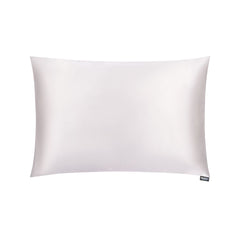
Also check that product photos, colour names and care directions refer to the item you are purchasing. A silk pillowcase may have different care needs from a lined mask or a silk-blend garment.
4. Treat shine and touch as clues, not proof
Real silk can have a soft lustre that changes with the angle of light, but finishes, dyes, weave and lighting affect appearance. Polyester satin can also look glossy and feel smooth. A quick touch test is subjective: room temperature, fabric weight and the person handling it all change the sensation.
Photos and price are just as limited. A polished photograph cannot verify fibre content, and an expensive listing is not automatically genuine. Use the written specification and seller transparency as your starting point.
5. Check certifications for what they actually cover
If a seller displays a certification, look up the exact programme and confirm that it applies to the product and colour you are considering. A chemical-safety or manufacturing standard can provide useful information within its scope, but it is not necessarily a test of fibre composition. Ask the seller what the certificate verifies.
6. Avoid the burn test and “ring test” shortcuts
Do not set fire to a pillowcase, garment or loose thread to identify silk. It can cause burns, damage the item or start a fire, and the result is not a dependable consumer certification method. Ring tests and temperature tests are also not a substitute for product documentation or laboratory analysis.
If fibre identity is important and the seller cannot answer, choose another seller or ask an accredited textile testing laboratory what sample and test would be appropriate. Keep any testing to a qualified lab rather than experimenting at home.
7. Compare care instructions before you buy
Care information can help you decide whether an item will fit your routine, even though it cannot prove the fibre by itself. DREAMSILK’s care instructions recommend pH-neutral liquid detergent; pillowcases may be hand washed or machine washed on a delicate 30°C cycle in a wash bag. Other silk items may have different instructions, so check the exact listing and label.
A simple silk-buying checklist
- Find a clear fibre-content statement; do not infer silk from “satin” or “silky”.
- Check product-specific specifications, dimensions and care instructions.
- Look for a seller with reachable contact details and answers to material questions.
- Confirm what any certification covers instead of treating a logo as proof of silk content.
- Skip fire, ring and touch tests; use documentation or qualified textile testing.
For more context, see where mulberry silk sits among luxury fabrics and our practical silk pillowcase washing guide. If you are comparing pillowcase materials, browse the DREAMSILK silk pillowcase collection.
Real silk FAQs
Does satin mean fake silk?
No. Satin describes a weave, not a fibre. Some satin is made from silk, while other satin is made from polyester or other fibres. Check the composition.
Can I tell real silk by its shine?
No. Shine can vary with weave, finish, dye and lighting, and synthetic satin can also look glossy. Use clear fibre information and seller details.
Is a burn test reliable?
It is unsafe for shoppers and can damage the product or cause a fire. Do not use it; ask the seller or a qualified textile laboratory instead.
Does OEKO-TEX prove a product is silk?
Not by itself. Check the current certificate and its scope; chemical-safety certification and fibre identification are different questions.
What is the safest way to check a silk pillowcase?
Read its fibre-content and care information, then ask the seller for details if anything is unclear. For certainty, seek professional textile testing.


Deje un comentario